Derivatives and Differentials
(I) Concepts of Derivatives and Differentials
1. Derivative
\[\begin{aligned} &\text{Definition 1: (Derivative) (Represents the rate of change at } x_0) \\ &f'(x_0)=\lim_{\Delta x\to 0} \tfrac{\Delta y}{\Delta x}=\lim_{\Delta x\to 0}\frac{f(x_0+\Delta x)-f(x_0)}{\Delta x}=\lim_{h\to 0}\frac{f(x_0+h)-f(x_0)}{h}\\ &\text{Definition 2: (Left Derivative) (Differentiable within the left neighborhood)}\\ &f_-'(x_0)=\lim_{\Delta x\to 0^-} \tfrac{\Delta y}{\Delta x}=\lim_{\Delta x\to 0^-}\frac{f(x_0+\Delta x)-f(x_0)}{\Delta x}=\lim_{h\to 0^-}\frac{f(x_0+h)-f(x_0)}{h}\\ &\text{Definition 3: (Right Derivative) (Differentiable within the right neighborhood)}\\ &f_+'(x_0)=\lim_{\Delta x\to 0^+} \tfrac{\Delta y}{\Delta x}=\lim_{\Delta x\to 0^+}\frac{f(x_0+\Delta x)-f(x_0)}{\Delta x}=\lim_{h\to 0^+}\frac{f(x_0+h)-f(x_0)}{h}\\ \end{aligned}\] \[\text{Theorem 1: } f'(x) \text{ exists } \Leftrightarrow f'_-(x) \text{ exists, } f'_+(x) \text{ exists, and } f'_-(x)=f'_+(x)\]2. Differential
\[\begin{align} &\text{Definition 4: (Differential) If } \Delta y=f(x_0+\Delta x)-f(x_0) \text{ can be expressed as:}\\ &\Delta y=A\Delta x+o(\Delta x)\\ &\text{Then the function } f(x) \text{ is said to be differentiable at point } x_0, \text{ and } A\Delta x \text{ is called the differential, denoted as } dy=A\Delta x\\ &dy\approx \Delta y \text{ (Replacing a non-uniform variable with a uniform variable in a tiny region)}\\ &\text{The differential is the linear principal part of the function increment.} \end{align}\] \[\text{Theorem 2: The function } y=f(x) \text{ is differentiable at point } x_0 \Leftrightarrow f(x) \text{ is derivable at point } x_0, \text{ and } dy=f'(x_0)\Delta x=f'(x_0)dx\]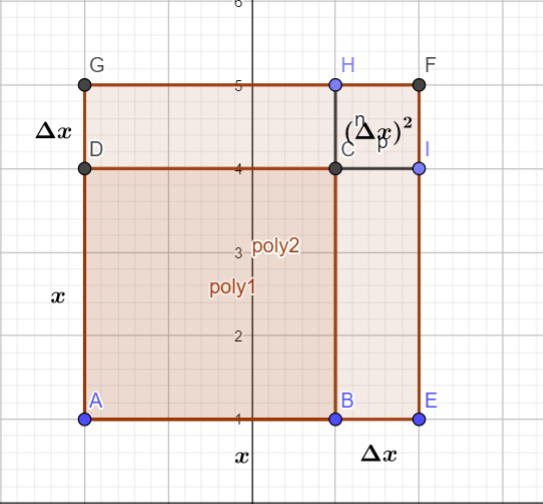 \(\begin{align}
&S(x)=x^2, S(x+\Delta x)=(x+\Delta x)^2\\
&\Delta S=(x+\Delta x)^2-x^2=2x\Delta x+(\Delta x)^2=2x\Delta x+o(\Delta x)\\
&\text{Linear Principal Part } (ds=2x\Delta x=S'(x)\Delta x) + \text{Higher-Order Infinitesimal}\\
&\Delta S\approx 2x\Delta x \quad (\Delta x\rightarrow 0)\\
&\\
&\Delta f(x)=A\Delta x+o(\Delta x) \quad (\Delta x\rightarrow 0)\Leftrightarrow \lim_{\Delta x \rightarrow 0}\frac{\Delta f(x)-A\Delta x}{\Delta x}=0\\
&(1) \text{ If } \exists A \text{ such that } \lim_{\Delta x \rightarrow 0}\frac{\Delta f-A\Delta x}{\Delta x} = 0\\
&(2) \text{ If } f \text{ is differentiable, then } \lim_{\Delta x \rightarrow 0}\frac{\Delta f-f'(x)\Delta x}{\Delta x}=0\\
\end{align}\)
\(\begin{align}
&S(x)=x^2, S(x+\Delta x)=(x+\Delta x)^2\\
&\Delta S=(x+\Delta x)^2-x^2=2x\Delta x+(\Delta x)^2=2x\Delta x+o(\Delta x)\\
&\text{Linear Principal Part } (ds=2x\Delta x=S'(x)\Delta x) + \text{Higher-Order Infinitesimal}\\
&\Delta S\approx 2x\Delta x \quad (\Delta x\rightarrow 0)\\
&\\
&\Delta f(x)=A\Delta x+o(\Delta x) \quad (\Delta x\rightarrow 0)\Leftrightarrow \lim_{\Delta x \rightarrow 0}\frac{\Delta f(x)-A\Delta x}{\Delta x}=0\\
&(1) \text{ If } \exists A \text{ such that } \lim_{\Delta x \rightarrow 0}\frac{\Delta f-A\Delta x}{\Delta x} = 0\\
&(2) \text{ If } f \text{ is differentiable, then } \lim_{\Delta x \rightarrow 0}\frac{\Delta f-f'(x)\Delta x}{\Delta x}=0\\
\end{align}\)
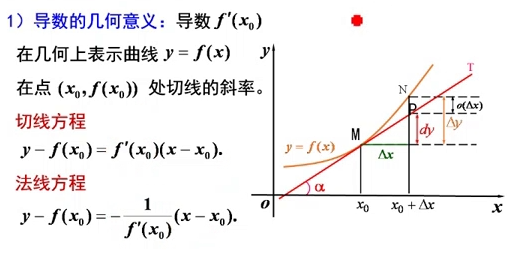
3. Geometric Meaning of Derivatives and Differentials

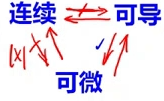
4. Relationships between Continuity, Derivability, and Differentiability
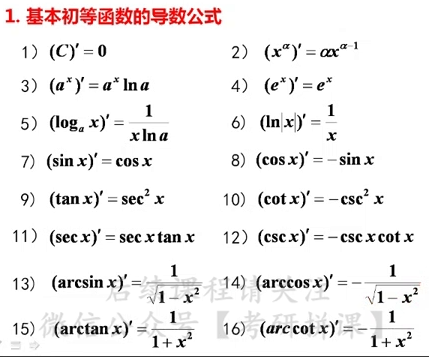
(II) Differentiation Formulas and Rules
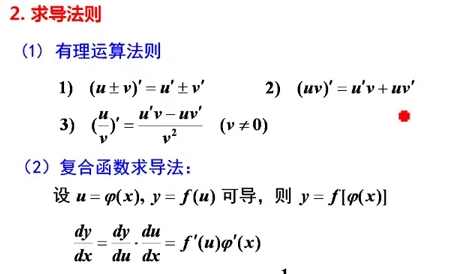
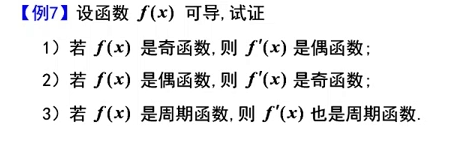
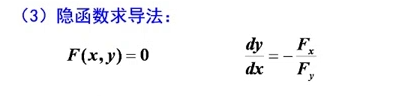
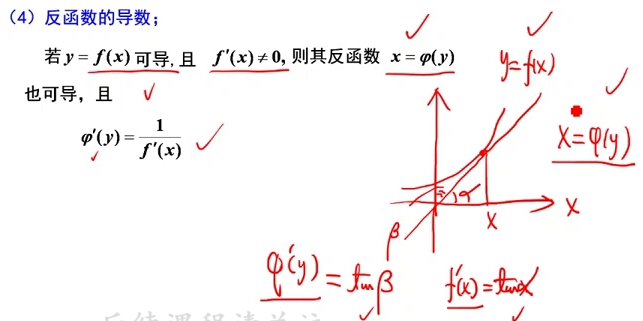
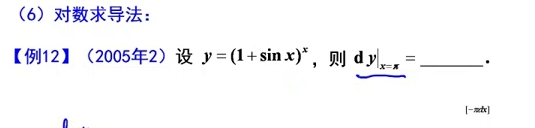
“Transform multiplication/division into addition/subtraction via logarithms” \(u^v=e^{v\ln{u}}\)
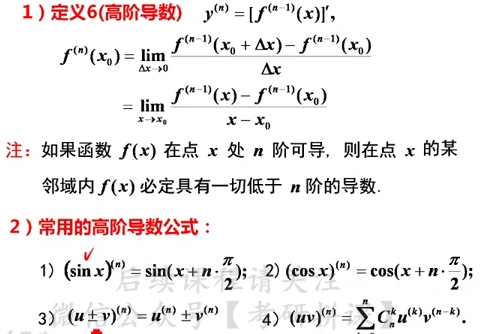
\[y=u^v \Leftrightarrow \ln{y}=v\ln{u}\]Higher-Order Derivatives
 \(\begin{align}
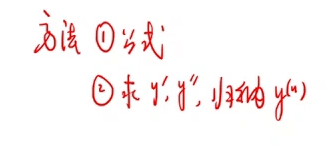
&\text{Given } y=\sin 3x, \text{ find } y^{(n)}:\\
&y'=\cos 3x \cdot 3 = \sin\left(3x+\frac{\pi}{2}\right) \cdot 3\\
&y''=\cos\left(3x+\frac{\pi}{2}\right) \cdot 3^2 = \sin\left(3x+2\cdot\frac{\pi}{2}\right) \cdot 3^2\\
&\Rightarrow y^{(n)}=\sin\left(3x+n\cdot\frac{\pi}{2}\right) \cdot 3^n\\
&y=\sin(ax+b) \Rightarrow y^{(n)}=a^n \sin\left(ax+b+n\cdot\frac{\pi}{2}\right)
\end{align}\)
\(\begin{align}
&\text{Given } y=\sin 3x, \text{ find } y^{(n)}:\\
&y'=\cos 3x \cdot 3 = \sin\left(3x+\frac{\pi}{2}\right) \cdot 3\\
&y''=\cos\left(3x+\frac{\pi}{2}\right) \cdot 3^2 = \sin\left(3x+2\cdot\frac{\pi}{2}\right) \cdot 3^2\\
&\Rightarrow y^{(n)}=\sin\left(3x+n\cdot\frac{\pi}{2}\right) \cdot 3^n\\
&y=\sin(ax+b) \Rightarrow y^{(n)}=a^n \sin\left(ax+b+n\cdot\frac{\pi}{2}\right)
\end{align}\)
(III) Methods of Differentiation
1. Differentiation of Composite and Elementary Functions
(1) Basic Differentials
.jpg)
(2) Composite Function Differentiation (Chain Rule)
\[\begin{align} &\text{Assume that } u=\Phi(x) \text{ is differentiable at point } x, \text{ and } y=f(u) \text{ is differentiable at point } u=\Phi(x).\\ &\text{Then the composite function } y=f(\Phi(x)) \text{ is differentiable at point } x, \text{ and } \frac{dy}{dx}=\frac{dy}{du}\cdot\frac{du}{dx}\\ &\text{Or written as: } [f(\Phi(x))]'=f'(\Phi(x))\Phi'(x)\\ \end{align}\]Examples
\[\begin{align} &\text{Let } u=\tan y, x=e^t. \text{ Transform the following equation regarding } y(x): F\left(\frac{d^2y}{dx^2},\frac{dy}{dx},y,x\right)=0\\ &\text{Solution:}\\ &y=y(u(t(x))), t=\ln x, y=\arctan u \Rightarrow y=\arctan(u(\ln x))\\ &\frac{dy}{dx}=\frac{dy}{du}\cdot\frac{du}{dt}\cdot\frac{dt}{dx}=\frac{1}{1+u^2}\cdot\frac{du}{dt}\cdot\frac{1}{x}\\ &\frac{d^2y}{dx^2}=\frac{d}{dx}\left[\frac{dy}{dx}\right] = \frac{d}{dt}\left[\frac{1}{1+u^2}\cdot\frac{du}{dt}\cdot\frac{1}{x}\right]\frac{dt}{dx}\\ &= \left( \frac{-2u}{(1+u^2)^2}\left(\frac{du}{dt}\right)^2\frac{1}{x} + \frac{1}{1+u^2}\frac{d^2u}{dt^2}\frac{1}{x} - \frac{1}{1+u^2}\frac{du}{dt}\frac{1}{x^2} \right) \cdot \frac{1}{x}\\ \end{align}\]2. Implicit Differentiation
Examples
\[\begin{align} &\text{Let } y=y(x) \text{ be defined by the equation } e^y+6xy+x^2-1=0, \text{ find } y''(0);\\ &\text{Let } y=y(x) \text{ be defined by the equation } xe^{f(y)}=e^y, f \text{ is twice differentiable, and } f'\neq1, \text{ find } y''(x).\\ &e^y \cdot y'+6y+6xy'+2x=0\\ &e^y \cdot y''+e^y \cdot (y')^2+6xy''+12y'+2=0\\ \end{align}\]Examples
1.
\[\begin{align} &\text{Given } f'(x_0)=-1, \text{ find } \lim_{x\rightarrow 0}\frac{x}{f(x_0-2x)-f(x_0-x)}=?\\ &\\ &\text{Solution 1:}\\ &I=\lim_{x\rightarrow 0}\frac{1}{-2\cdot\frac{f(x_0-2x)-f(x_0)}{-2x}+\frac{f(x_0-x)-f(x_0)}{-x}}=\frac{1}{-2(-1) + (-1)} = 1 \quad \text{(Note: Check sign alignment below)}\\ &\text{Alternative approach via definition:}\\ &I = \lim_{x\rightarrow 0}\frac{1}{\frac{f(x_0-2x)-f(x_0-x)}{x}} = \frac{1}{-2f'(x_0) - (-f'(x_0))} = \frac{1}{-f'(x_0)} = \frac{1}{-(-1)} = 1\\ \end{align}\]2.
\[\begin{align} &\text{Suppose } f(x) \text{ is continuous at } x=0, \text{ and } \lim_{h\rightarrow0}\frac{f(h^2)}{h^2}=1, \text{ then:}\\ &(A) f(0)=0 \text{ and } f_{-}'(0) \text{ exists.}\\ &(B) f(0)=1 \text{ and } f_{-}'(0) \text{ exists.}\\ &(C) f(0)=0 \text{ and } f_{+}'(0) \text{ exists.}\\ &(D) f(0)=1 \text{ and } f_{+}'(0) \text{ exists.}\\ &\\ &\text{Solution:}\\ &\text{Since } f(x) \text{ is continuous at } x=0, \lim_{x\rightarrow 0}f(x)=f(0).\\ &\text{Since } \lim_{h\rightarrow0}\frac{f(h^2)}{h^2}=1, \text{ as } h\rightarrow0, h^2\rightarrow 0^+, \text{ meaning } \lim_{h\rightarrow 0}f(h^2)=0 \Rightarrow f(0)=0.\\ &\text{Let } t=h^2 \rightarrow 0^+, \text{ then } \lim_{t\rightarrow0^+}\frac{f(t)}{t}=\lim_{t\rightarrow0^+}\frac{f(t)-f(0)}{t-0}=1 \Leftrightarrow f_{+}'(0) \text{ exists and equals } 1. \text{ Thus, (C) is correct.}\\ \end{align}\]3.
\[\begin{align} &\text{Let } f(x)=|x^3-1|\Phi(x), \text{ where } \Phi(x) \text{ is continuous at } x=1. \text{ Find the necessary and sufficient condition for } f(x) \text{ to be differentiable at } x=1 \text{ for } \Phi(1)=?\\ &\text{Analysis: Under what condition is } f(x) \text{ differentiable at } x=1?\\ &\text{Solution:}\\ &\text{Note that } f(1) = 0.\\ &\lim_{x\rightarrow 1^+}\frac{f(x)-f(1)}{x-1}=\lim_{x\rightarrow 1^+}\frac{(x^3-1)\Phi(x)}{x-1}=\lim_{x\rightarrow 1^+}\frac{(x-1)(x^2+x+1)\Phi(x)}{x-1}=3\Phi(1)\\ &\lim_{x\rightarrow 1^-}\frac{f(x)-f(1)}{x-1}=\lim_{x\rightarrow 1^-}\frac{-(x^3-1)\Phi(x)}{x-1}=\lim_{x\rightarrow 1^-}\frac{-(x-1)(x^2+x+1)\Phi(x)}{x-1}=-3\Phi(1)\\ &\\ &\text{For } f(x) \text{ to be differentiable at } x=1, \text{ the left and right derivatives must be equal: } 3\Phi(1)=-3\Phi(1) \Rightarrow \Phi(1)=0.\\ &\text{Note: } a^n-b^n=(a-b)(a^{n-1}b^0+a^{n-2}b^1+\dots+a^0b^{n-1}) \end{align}\]4.
\[\begin{align} &\text{Suppose } f(x) \text{ is continuous at } x=1, \text{ and } \lim_{x\rightarrow 1}\frac{f(x)}{x-1}=2, \text{ find } f'(1).\\ &\text{Solution:}\\ &\lim_{x \rightarrow 1}f(x)=f(1)\\ &\text{Since the limit exists, } f(1) = \lim_{x \rightarrow 1}\frac{f(x)}{x-1}(x-1)=2\cdot 0=0\\ &f'(1)=\lim_{x \rightarrow 1}\frac{f(x)-f(1)}{x-1}=\lim_{x \rightarrow 1}\frac{f(x)}{x-1}=2 \end{align}\]III. Differentiation of Functions Defined by Parametric Equations
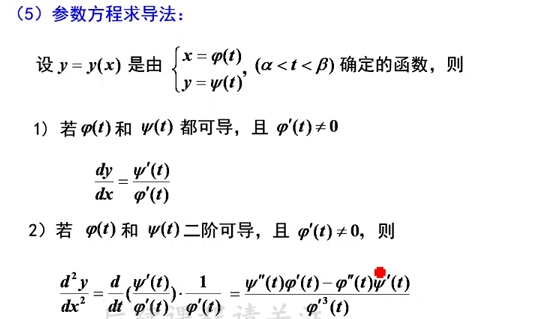
\[\begin{align} &\text{Let } y=y(x) \text{ be defined by the parametric equations } \begin{cases}x=x(t)\\y=y(t)\end{cases}, \text{ then:}\\ &\frac{dy}{dx}=\frac{y'(t)}{x'(t)}\\ &\frac{d^2y}{dx^2}=\frac{d}{dt}\left(\frac{dy}{dx}\right)\cdot\frac{dt}{dx} = \frac{\frac{d}{dt}\left[\frac{y'(t)}{x'(t)}\right]}{x'(t)} = \frac{y''(t)x'(t)-y'(t)x''(t)}{[x'(t)]^3}\\ \end{align}\]Example: \(\begin{align} &y=y(x) \text{ is defined by } \begin{cases}x=\ln (1+t^2)\\y=t-\arctan t\end{cases}, \text{ find } \frac{d^2y}{dx^2}.\\ &\frac{dy}{dx}=\frac{1 - \frac{1}{1+t^2}}{\frac{2t}{1+t^2}}=\frac{\frac{t^2}{1+t^2}}{\frac{2t}{1+t^2}}=\frac{t}{2}\\ &\frac{d^2y}{dx^2}=\frac{\frac{d}{dt}\left(\frac{t}{2}\right)}{x'(t)} = \frac{\frac{1}{2}}{\frac{2t}{1+t^2}}=\frac{t^2+1}{4t}\\ \end{align}\)
IV. Differentiation of Inverse Functions
\[\begin{align} &\text{Let } y=f(x) \text{ be twice differentiable and } f'(x)\neq0, \text{ its inverse function is } x=f^{-1}(y).\\ &\text{Then: } \frac{dx}{dy}=\frac{1}{\frac{dy}{dx}}=\frac{1}{f'(x)}, \quad \frac{d^2x}{dy^2}=\frac{d}{dy}\left(\frac{1}{f'(x)}\right) = -\frac{f''(x)\frac{dx}{dy}}{[f'(x)]^2} = -\frac{f''(x)}{[f'(x)]^3} \end{align}\]V. Differentiation of Piecewise Functions
Differentiate normally using standard rules within open intervals. At boundary points, apply definitions of limits/derivatives and verify if the left and right derivatives match.
\[\begin{align} &\text{Let } f(x)=\begin{cases}1-2x^2, &x\leq -1\\x^3, &-1< x\leq2\\12x-16, &x> 2\end{cases}\\ &(1) \text{ Find the inverse function } g(x).\\ &(2) \text{ Check if } g(x) \text{ has any points of discontinuity or non-differentiability.} \end{align}\]