Indefinite, Definite, and Improper Integrals
Indefinite Integrals
I. Concepts of Indefinite Integral
1. Definition
\[\begin{align} &\text{Antiderivative: If for every point } x \text{ in the interval } I, \text{ we have } F'(x)=f(x), \text{ then } F(x) \text{ is called an antiderivative of } f(x) \text{ on } I.\\ &\text{Indefinite Integral: If } f(x) \text{ has antiderivatives on } I, \text{ the set of all its antiderivatives is called the indefinite integral of } f(x) \text{ on } I, \text{ denoted as } \int{f(x)dx}.\\ &\text{Linearity: } \int[\alpha f(x)+\beta g(x)]dx=\alpha\int f(x)dx+\beta\int g(x)dx\\ \end{align}\]2. Evaluation
\[\begin{align} &\text{Methods of Evaluation}\begin{cases}&1. \text{Basic Formulas}\\&2. \text{Linearity}\\&3. \text{Integration Methods}\begin{cases}&1. \text{Substitution Method}\\&2. \text{Integration by Parts}\\\end{cases}\\\end{cases}\\ \end{align}\](1) Integration by Substitution - First Method (Differential Matching)
\[\begin{align} &\text{Let } F'(u)=f(u), \text{ then } \int{f(\Phi(x))\Phi'(x)}dx=\int{f(\Phi(x))d(\Phi(x))}=F(\Phi(x))+C\\ &\text{Note: Find a suitable differential matching } \Phi'(x)dx=d(\Phi(x)) \end{align}\]Common Differential Matchings: \(\begin{align} &1. \int{f(ax+b)dx=\frac{1}{a}\int{f(ax+b)d(ax+b)}} \quad (a\neq0)\\ &\text{eg1. } \int{\sin (2x+3)}dx=\frac{1}{2}\int\sin (2x+3)d(2x+3)=-\frac{1}{2}\cos{(2x+3)}+C\\ &2. \int{f(ax^n+b)x^{n-1}dx}=\frac{1}{na}\int{f(ax^n+b)d(ax^n+b)}\\ &\text{eg2. } \int{\cos(2x^4+3)x^3dx}=\frac{1}{4\cdot2}\int{\cos(2x^4+3)d(2x^4+3)}=\frac{1}{8}\sin{(2x^4+3)}+C\\ &3. \int{f(a^x+c)a^xdx}=\frac{1}{\ln{a}}\int{f(a^x+c)}d(a^x+c)\\ &\text{eg3. } \int{\sin(2^x+3)2^xdx}=\frac{1}{\ln2}\int{\sin{(2^x+3)}d(2^x+3)}=-\frac{1}{\ln 2}\cos{(2^x+3)}+C\\ &4. \int{f\left(\frac{1}{x}\right)\frac{1}{x^2}}dx=-\int{f\left(\frac{1}{x}\right)}d\left(\frac{1}{x}\right)\\ &\text{eg4. } \int{\ln\left(\frac{1}{x}\right)}\frac{1}{x^2}dx=-\int\ln \left(\frac{1}{x}\right)d\left({\frac{1}{x}}\right)+C\\ &5. \int{f(\ln |x|})\frac{1}{x}dx=\int{f(\ln{|x|)}}{d(\ln|x|)}\\ &\text{eg5. } \int{\sin ({\ln{|x|}}})\frac{1}{x}dx=\int{\sin(\ln|x|)d(\ln{|x|})}=-\cos(\ln |x|)+C\\ &6. \int{f(\sqrt x)\frac{1}{\sqrt x}}dx=2\int{f(\sqrt x)}d(\sqrt x)\\ &7. \int f(\sin x)\cos xdx=\int{f(\sin x)}d(\sin x)\\ &8. \int{f(\cos x)\sin x}dx=-\int{f(\cos x)d(\cos x)}\\ &9. \int{f(\tan x)\sec^2 xdx}=\int{f(\tan x)d(\tan x)}\\ &10. \int{f(\cot x)\csc^2xdx}=-\int{f(\cot x)d{(\cot x)}}\\ &11. \int{f\left(\arcsin x\right)\frac{1}{\sqrt{1-x^2}}}dx=\int{f(\arcsin x)d({\arcsin x})}\\ &12. \int{f(\arccos x)\left(-\frac{1}{\sqrt{1-x^2}}\right)}dx=\int{f(\arccos x)d(\arccos x)}\\ &13. \int{f(\arctan x)\frac{1}{1+x^2}dx}=\int{f(\arctan x)d(\arctan x)}\\ &14. \int{f(\sqrt{x^2\pm a})}\frac{x}{\sqrt{x^2\pm a}}dx=\int{f(\sqrt{x^2\pm a})}d(\sqrt{x^2\pm a})\\ &\text{Note: } (\sqrt{x^2\pm a})'=\frac{x}{\sqrt{x^2\pm a}}, \quad (\sqrt{a^2-x^2})'=\frac{-x}{\sqrt{a^2-x^2}}\\ \end{align}\)
(2) Integration by Substitution - Second Method
\[\begin{align} &\text{Let } F'(u)=f(\Phi(u))\Phi'(u), \text{ then }\\ &\int{f(x)dx}\overset{x=\Phi(u)}{=}\int{f(\Phi(u))\Phi'(u)du}=F(u)+C=F(\Phi^{-1}(x))+C\\ &\text{Note: Find a suitable substitution } x=\Phi(u)\\ \end{align}\]1) Trigonometric Substitution \(\begin{align} &x=a\sin u, \quad x=a\tan u, \quad x=a \sec u\\ &\sqrt{a^2-x^2}\overset{x=a\sin u}{=}a\cos u, \quad u\in\left[-\frac{\pi}{2},\frac{\pi}{2}\right], \quad x\in[-a,a]\\ &\sqrt{a^2+x^2}\overset{x=a\tan u}{=}a\sec u, \quad u\in{\left(-\frac{\pi}{2},\frac{\pi}{2}\right)}, \quad x\in{(-\infty,\infty)}\\ &\sqrt{x^2-a^2}\overset{x=a\sec u}{=}a\tan u, \quad u\in\left(\frac{\pi}{2},\pi\right]\cup\left(0,\frac{\pi}{2}\right]\\ \end{align}\) 2) Reciprocal Substitution \(\begin{align} &x=\frac{1}{u} \quad \text{commonly used for functions containing } \frac{1}{x}\\ \end{align}\) 3) Exponential (or Logarithmic) Substitution \(\begin{align} &a^x=u \text{ or } x=\frac{\ln u}{\ln a} \quad \text{commonly used for functions containing } a^x\\ \end{align}\) 4) Substitutions for Rationalization \(\begin{align} &\text{For } \frac{1}{\sqrt{x}+\sqrt[3]{x}}, \text{ use } x=u^6\\ &\text{For } \sqrt[n]{\frac{ax+b}{cx+d}}, \text{ use } u=\sqrt[n]{\frac{ax+b}{cx+d}} \text{ or } x=-\frac{du^n-b}{cu^n-a}\\ \end{align}\)
(3) Integration by Parts
\[\begin{align} &\int{u(x)v'(x)dx}=\int{u(x)d(v(x))}=u(x)v(x)-\int{v(x)u'(x)dx}\\ &\text{Note: Find suitable functions } u(x) \text{ and } v(x)\\ \end{align}\]1) Degree Reduction Method \(\begin{align} &\int{x^ne^{ax}dx}, \quad \int{x^n\sin axdx}, \quad \int{x^n\cos ax dx}\\ &\text{Choose } u(x)=x^n\\ \end{align}\) 2) Order Raising Method \(\begin{align} &\int{x^a\ln xdx}, \quad \int{x^a\arcsin xdx}, \quad \int{x^a\arccos x dx}, \quad \int{x^a\arctan x dx}\\ &\text{Choose } u(x)=\ln x, \arcsin x, \text{ etc.}\\ \end{align}\) 3) Cyclic Method \(\begin{align} &\int{e^{ax}\sin bx dx}, \quad \int{e^{ax}\cos {bx} dx}\\ &\text{Choose } u(x)=e^{ax} \text{ or } \sin{bx}\\ \end{align}\) 4) Reduction Formula Method \(\begin{align} &\text{For results } I_n \text{ involving } n, \text{ establish a recursive relation } I_n=f(I_{n-1}) \text{ or } f(I_{n-2})\\ \end{align}\)
Definite Integrals
I. Concepts of Definite Integral
1. Definition
\[\begin{align} &\text{Definition: Let the function } f(x) \text{ be defined and bounded on the interval } [a,b].\\ &(1) \text{ Partition: Divide } [a,b] \text{ into } n \text{ subintervals } [x_{i-1},x_{i}].\\ &(2) \text{ Summation: Choose a point } \xi_{i} \in [x_{i-1},x_{i}], \text{ form the sum } \sum_{i=1}^{n}{f(\xi_{i})\Delta x_i}, \text{ where } \lambda=\max\{\Delta x_{1},\Delta x_{2},...,\Delta x_{n}\}.\\ &(3) \text{ Limit: If } \lim_{\lambda \rightarrow 0}{\sum_{i=1}^{n}f(\xi_{i})\Delta x_i} \text{ exists and the limit is independent of the partition of } [a,b] \text{ and choice of } \xi_{i},\\ &\text{then } f(x) \text{ is integrable on } [a,b], \text{ denoted as } \int^{b}_{a}{f(x)dx}=\lim_{\lambda \rightarrow 0}{\sum_{i=1}^{n}f(\xi_i)\Delta x_{i}}\\ &\\ &\text{Notes:}\\ &(1) \lambda \rightarrow 0 \implies n \rightarrow \infty, \text{ but } n \rightarrow \infty \nimplies \lambda \rightarrow 0 \text{ unless the partition is regular.}\\ &(2) \text{ A definite integral represents a single value, dependent on } [a,b] \text{ but independent of the variable of integration } x.\\ &\int_{a}^{b}{f(x)dx}=\int_{a}^{b}{f(t)dt}\\ &(3) \text{ If } \int_{0}^{1}{f(x)dx} \text{ exists, dividing } [0,1] \text{ into } n \text{ equal parts gives } \Delta{x_{i}}=\frac{1}{n}. \text{ Choosing } \xi_{i}=\frac{i}{n}:\\ &\int_{0}^{1}f(x)dx=\lim_{\lambda \rightarrow 0}{\sum_{i=1}^{n}{f(\xi_{i})\Delta x_{i}}}=\lim_{n\rightarrow \infty}\sum_{i=1}^{n}\frac{1}{n}f\left(\frac{i}{n}\right)\\ \end{align}\] \[\begin{align} &\int^{b}_{a}{f(x)dx}=\lim_{\lambda \rightarrow 0}\sum^{n}_{i=1}f(\xi_i)\Delta x_i=\begin{cases}&\lim_{n\rightarrow \infty}{\sum_{i=1}^{n}{f\left(a+(i-1)\frac{b-a}{n}\right)\frac{b-a}{n}}}, \text{ Left endpoints}\\\\&\lim_{n\rightarrow \infty}{\sum_{i=1}^{n}{f\left(a+i\frac{b-a}{n}\right)\frac{b-a}{n}}}, \text{ Right endpoints}\\\end{cases}\\ &\text{Midpoints: } \xi_i=a+(i-1)\frac{b-a}{n}+\frac{b-a}{2n}\\ \end{align}\]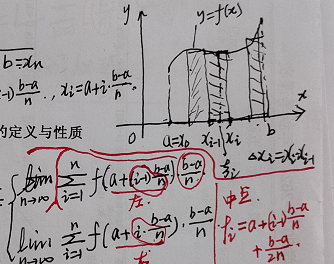
Theorem: (Linearity) \(\begin{align} &\int_a^b[\alpha f(x)+\beta g(x)]dx=\alpha\int_a^b f(x)dx+\beta\int_a^b g(x)dx\\ \end{align}\) Note: Integration is subtle \(\begin{align} &\int{e^{\pm x^2}dx}, \int{\frac{\sin x}{x}dx} \text{ cannot be integrated in terms of elementary functions.}\\ &\text{If } F'(x)=f(x), x\in I, \text{ any continuous function must have antiderivatives (infinitely many).}\\ &[F(x)+C]'=f(x) \end{align}\)
2. Sufficient Conditions for the Existence of Definite Integrals
\[\begin{align} &\text{If } f(x) \text{ is continuous on } [a,b], \text{ then } \int^{b}_{a}{f(x)dx} \text{ definitely exists.}\\ &\text{If } f(x) \text{ is bounded on } [a,b] \text{ and has only finitely many discontinuities, then } \int^{b}_{a}{f(x)dx} \text{ definitely exists.}\\ &\text{If } f(x) \text{ has only finitely many jump or removable discontinuities on } [a,b], \text{ then } \int^{b}_{a}{f(x)dx} \text{ definitely exists.}\\ \end{align}\]3. Geometric Meaning of Definite Integrals
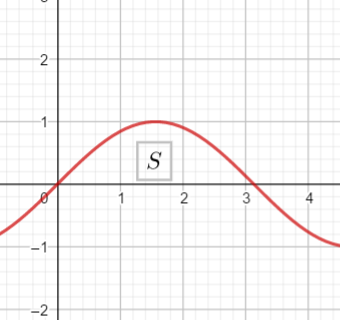 \(\begin{align}
&(1) \text{ If } f(x)\geqslant{0}, \quad \int_{a}^{b}{f(x)dx}=S\\
\end{align}\)
\(\begin{align}
&(1) \text{ If } f(x)\geqslant{0}, \quad \int_{a}^{b}{f(x)dx}=S\\
\end{align}\)
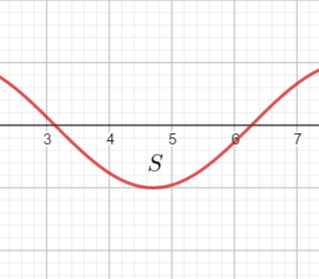 \(\begin{align}
&(2) \text{ If } f(x)\leqslant{0}, \quad \int_{a}^{b}{f(x)dx}=-S\\
\end{align}\)
\(\begin{align}
&(2) \text{ If } f(x)\leqslant{0}, \quad \int_{a}^{b}{f(x)dx}=-S\\
\end{align}\)
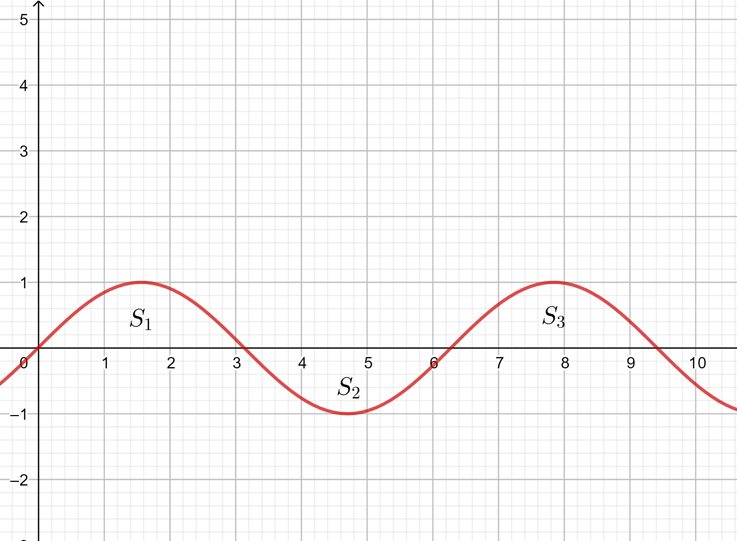 \(\begin{align}
&(3) \text{ General case: } \int_{a}^{b}{f(x)dx}=S_1+S_3-S_2\\
\end{align}\)
\(\begin{align}
&(3) \text{ General case: } \int_{a}^{b}{f(x)dx}=S_1+S_3-S_2\\
\end{align}\)
Notes: \(\begin{align} &\text{(1) When } f(x)\geq0, \text{ the geometric meaning is the area of the curvilinear trapezoid bounded by } y=f(x), x=a, x=b, \text{ and the } x\text{-axis.}\\ &\text{(2) A definite integral is a constant that depends only on } f \text{ and the interval } [a,b], \text{ not on the variable symbol.}\\ &\int_a^b{f(x)}dx=\int_a^b{f(t)dt}\\ &\text{(3) } \int_a^bdx=b-a\\ &\text{(4) } \int_{a}^{a}f(x)dx=0, \quad \int_a^bf(x)dx=-\int_b^a{f(t)}dt \end{align}\)
II. Properties of Definite Integrals
1. Inequality Properties
\[\begin{align} &(1) \text{ Monotonicity: If } f(x)\leqslant{g(x)} \text{ on } [a,b], \text{ then } \int_a^{b}{f(x)dx}\leqslant{\int_a^{b}{g(x)dx}}\\ &\text{Corollaries:}\\ &(1) \text{ If } f(x)\geq0 \text{ for all } x\in[a,b], \text{ then } \int_a^b{f(x)dx}\geq0\\ &(2) \text{ If } f(x)\geq0 \text{ for all } x\in[a,b] \text{ and } [c,d]\subset[a,b], \text{ then } \int_a^b{f(x)dx}\geq\int_c^d{f(x)dx}\\ &(3) \left|\int_a^bf(x)dx\right|\leq\int_a^b{|f(x)|dx}\\ &\quad -|f|\leq f\leq |f|\implies \int_a^b-|f|dx\leq \int_a^bfdx\leq \int_a^b|f|dx\implies \left|\int_a^bfdx\right|\leq\int_a^b|f|dx\\ &\quad \text{Example: Since } x^3\leq x^2 \text{ on } [0,1], \text{ then } \int_0^1{x^3dx}\leq\int_0^1{x^2dx}\\ \end{align}\] \[\begin{align} &(4) \text{ (Estimation Theorem) If } M \text{ and } m \text{ are the maximum and minimum values of } f(x) \text{ on } [a,b] \text{ respectively,}\\ &\text{then } m(b-a)\leqslant{\int_a^{b}{f(x)dx}\leqslant{M(b-a)}}\\ \end{align}\]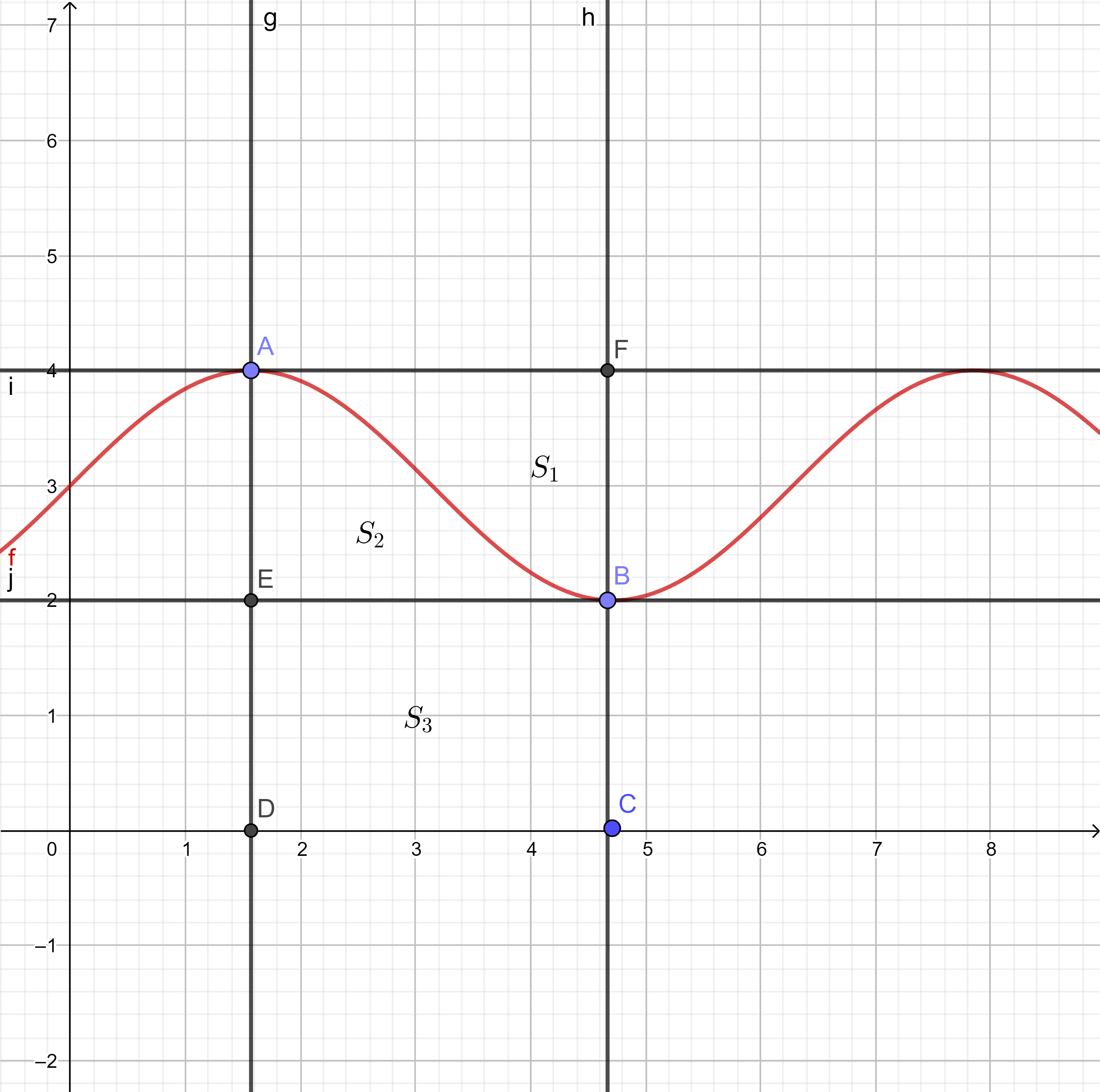 \(\begin{align}
&\text{Proof: } M(b-a)=S_{AFDC}=S_1+S_2+S_3\\
&m(b-a)=S_{EBDC}=S_3\\
&\int_a^{b}{f(x)dx}=S_{ADBC}=S_2+S_3\\
&\text{Since } S_3\leqslant{S_2+S_3\leqslant{S_1+S_2+S_3}}\\
&\implies{m(b-a)\leqslant{\int_a^{b}{f(x)dx}\leqslant{M(b-a)}}}\\
\end{align}\)
\(\begin{align}
&\text{Proof: } M(b-a)=S_{AFDC}=S_1+S_2+S_3\\
&m(b-a)=S_{EBDC}=S_3\\
&\int_a^{b}{f(x)dx}=S_{ADBC}=S_2+S_3\\
&\text{Since } S_3\leqslant{S_2+S_3\leqslant{S_1+S_2+S_3}}\\
&\implies{m(b-a)\leqslant{\int_a^{b}{f(x)dx}\leqslant{M(b-a)}}}\\
\end{align}\)
2. Mean Value Theorems
\[\begin{align} &(1) \text{ First Mean Value Theorem for Integrals: If } f(x) \text{ is continuous on } [a,b], \text{ then } \int_a^{b}{f(x)dx}=f(\xi)(b-a), \quad (a<\xi<b)\\ &\text{The value } \frac{1}{b-a}{\int_{a}^{b}{f(x)dx}} \text{ is called the average value of the function } y=f(x) \text{ on the interval } [a,b].\\ &\text{Note: Let } F'(x)=f(x), \text{ then } F(b)-F(a)=\int_a^b{f(x)dx}, \text{ and } f(\xi)(b-a)=F'(\xi)(b-a) \text{ by MVT.}\\ &(2) \text{ Generalized MVTI: If } f(x), g(x) \text{ are continuous on } [a,b], \text{ and } g(x) \text{ does not change sign, then } \int_{a}^{b}{f(x)g(x)dx}=f(\xi)\int_a^b{g(x)dx}\\ \end{align}\]Notes: \(\begin{align} &\text{Consider } \int_0^1{\frac{x}{\sin x}}dx\\ &f(x)=\begin{cases}&\frac{x}{\sin x}, \quad x\in(0,1]\\&1, \quad x=0\\\end{cases}\\ &\text{Conclusion: Modifying a function at finitely many points does not affect its definite integral.}\\ &\text{For } f(x)={\begin{cases}&x+1, \quad x\in[1,2]\\&x, \quad x\in[0,1)\\\end{cases}}\\ &\int_0^2{f(x)dx}=\int_0^1{xdx}+\int_1^2{(x+1)dx}\\ \end{align}\)
\[\begin{align} &\text{Proof Example: Show that } \frac{1}{2}\leq\int_0^{\frac{1}{2}}\frac{1}{\sqrt{1-x^n}}dx\leq\frac{\pi}{6} \quad (n \geq 2)\\ &\text{Estimation: For } x\in\left[0,\frac{1}{2}\right], \text{ we have } 1 \leq \frac{1}{\sqrt{1-x^n}} \leq \frac{1}{\sqrt{1-x^2}}\\ &\implies \int_0^{\frac{1}{2}} 1 dx \leq \int_0^{\frac{1}{2}}\frac{1}{\sqrt{1-x^n}}dx \leq \int_0^{\frac{1}{2}}\frac{1}{\sqrt{1-x^2}}dx = \arcsin\left(\frac{1}{2}\right) = \frac{\pi}{6}\\ \end{align}\]Examples: \(\begin{align} &1. \text{ Find the limit } \lim_{n\rightarrow \infty}\int_0^1{\frac{x^ne^x}{1+e^x}dx}\\ &\text{Since } 0\leq\frac{x^ne^x}{1+e^x}\leq x^n \text{ for } x\in[0,1], \text{ by monotonicity:}\\ &0\leq\int_0^1{\frac{x^ne^x}{1+e^x}dx}\leq \int_0^1{x^n}dx=\frac{1}{n+1}\\ &\text{Using the Squeeze Theorem and knowing } \lim_{n\rightarrow\infty}\frac{1}{n+1}=0:\\ &\lim_{n\rightarrow \infty}\int_0^1{\frac{x^ne^x}{1+e^x}dx}=0\\ \end{align}\)
\[\begin{align} &2. \text{ Let } I_1=\int_0^{\frac{\pi}{4}}\frac{\tan x}{x}dx, \quad I_2=\int_0^{\frac{\pi}{4}}\frac{x}{\tan x}dx. \text{ Then:}\\ &\text{(A) } I_1 < I_2 < 1 \quad \text{(B) } I_2 < 1 < I_1 \quad \text{(C) } I_2 < I_1 < 1 \quad \text{(D) } 1 < I_2 < I_1\\ &\text{Solution: Use monotonicity. Since } \tan x > x \text{ for } x\in\left(0,\frac{\pi}{2}\right):\\ &\frac{\tan x}{x} > 1 > \frac{x}{\tan x} \quad \text{on } \left(0,\frac{\pi}{4}\right]\\ &\text{Integrating over } \left[0,\frac{\pi}{4}\right]:\\ &\int_0^{\frac{\pi}{4}}\frac{x}{\tan x}dx < \int_0^{\frac{\pi}{4}}1dx = \frac{\pi}{4} < 1\\ &\text{For } I_1, \text{ by the integral mean value theorem:}\\ &I_1 = \int_0^{\frac{\pi}{4}}\frac{\tan x}{x}dx = \frac{\tan \xi}{\xi}\left(\frac{\pi}{4}\right) \quad \text{for some } \xi\in\left(0,\frac{\pi}{4}\right)\\ &\text{Since } \frac{\tan x}{x} \text{ is strictly increasing on } \left(0,\frac{\pi}{4}\right], \text{ its minimum value approaches } 1 \text{ as } x \rightarrow 0^.\\ &\text{Thus } \frac{\tan \xi}{\xi} > 1, \text{ but this doesn't immediately force } I_1 > 1 \text{ since } \frac{\pi}{4} < 1.\\ &\text{Let's re-evaluate the relation: } I_2 < \frac{\pi}{4} < 1.\\ &\text{Actually, evaluating at the endpoint } x=\frac{\pi}{4}, \frac{\tan(\pi/4)}{\pi/4} = \frac{4}{\pi} > 1.\\ &\text{Therefore, } I_2 < 1. \text{ For } I_1, \text{ since } \frac{\tan x}{x} > 1 \implies I_1 > \frac{\pi}{4}. \text{ Let's look at choice structural design:}\\ &\text{Since } \frac{\tan x}{x} > 1 > \frac{x}{\tan x}, \text{ then } I_2 < \frac{\pi}{4} < I_1. \text{ Also } I_1 = \frac{\tan\xi}{\xi}\frac{\pi}{4}. \text{ Since } \xi < \frac{\pi}{4}, \frac{\tan\xi}{\xi} < \frac{4}{\pi} \implies I_1 < 1.\\ &\text{Thus } I_2 < I_1 < 1. \text{ Choose (C).}\\ \end{align}\]III. Functions Defined by Integrals (Variable Upper Limit)
 \(\begin{align}
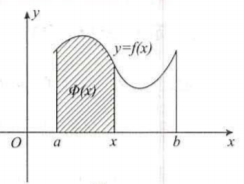
&\text{If } f(x) \text{ is continuous on } [a,b], \text{ then } \Phi(x)=\int_a^x{f(t)dt} \text{ is differentiable on } [a,b], \text{ and:}\\
&\left(\int_a^xf(t)dt\right)'=f(x), \quad \left(\int_a^{x^2}f(t)dt\right)'=f(x^2)\cdot 2x\\
&\text{If } f(x) \text{ is continuous on } [a,b], \text{ and } \phi_1(x), \phi_2(x) \text{ are differentiable functions, then:}\\
&\left(\int_{\phi_1(x)}^{\phi_2(x)}{f(t)dt}\right)' = f[\phi_2(x)]\cdot\phi_2'(x)-f[\phi_1(x)]\cdot\phi_1'(x)\\
\\
&\text{Let } f(x) \text{ be continuous on } [-l,l]:\\
&\text{If } f(x) \text{ is an odd function, then } \int_0^xf(t)dt \text{ must be an even function.}\\
&\text{If } f(x) \text{ is an even function, then } \int_0^xf(t)dt \text{ must be an odd function.}\\
\end{align}\)
\(\begin{align}
&\text{If } f(x) \text{ is continuous on } [a,b], \text{ then } \Phi(x)=\int_a^x{f(t)dt} \text{ is differentiable on } [a,b], \text{ and:}\\
&\left(\int_a^xf(t)dt\right)'=f(x), \quad \left(\int_a^{x^2}f(t)dt\right)'=f(x^2)\cdot 2x\\
&\text{If } f(x) \text{ is continuous on } [a,b], \text{ and } \phi_1(x), \phi_2(x) \text{ are differentiable functions, then:}\\
&\left(\int_{\phi_1(x)}^{\phi_2(x)}{f(t)dt}\right)' = f[\phi_2(x)]\cdot\phi_2'(x)-f[\phi_1(x)]\cdot\phi_1'(x)\\
\\
&\text{Let } f(x) \text{ be continuous on } [-l,l]:\\
&\text{If } f(x) \text{ is an odd function, then } \int_0^xf(t)dt \text{ must be an even function.}\\
&\text{If } f(x) \text{ is an even function, then } \int_0^xf(t)dt \text{ must be an odd function.}\\
\end{align}\)
\(\begin{align} &\text{Proof sketch: Take } x\in[a,b), \Delta x > 0 \text{ such that } x+\Delta x\in[a,b):\\ &\frac{\Delta F}{\Delta x}=\frac{F(x+\Delta x)-F(x)}{\Delta x}=\frac{1}{\Delta x}\left[\int_a^{x+\Delta x}f(t)dt-\int_a^xf(t)dt\right]=\frac{1}{\Delta x}\int_x^{x+\Delta x}f(t)dt=f(x+\theta\Delta x)\rightarrow f(x) \quad (\Delta x\rightarrow 0^+)\\ \end{align}\) Corollaries: \(\begin{align} &\text{If } f(x), \phi'(x), \psi'(x) \text{ are continuous on } [a,b], \text{ then:}\\ &(1) \left(\int_a^{\phi(x)}f(t)dt\right)'=f(\phi(x))\phi'(x)\\ &(2) \left(\int_{\psi(x)}^b f(t)dt\right)'=-f(\psi(x))\psi'(x)\\ &(3) \left(\int_{\psi(x)}^\phi(x)}f(t)dt\right)'=f(\phi(x))\phi'(x)-\f(\psi(x))\psi'(x)\\ \end{align}\) Examples: \(\begin{align} &1. \text{ If } f(x) \text{ is continuous and odd on } \mathbb{R}, \text{ show that its antiderivatives are even. What if } f(x) \text{ is even?}\\ &\text{Proof:}\\ &\text{Let } F_0(x) = \int_0^xf(t)dt, \quad x\in \mathbb{R}\\ &F_0(-x)=\int_0^{-x}f(t)dt\overset{t=-u}{=}\int_0^x f(-u)d(-u)=\int_0^x -f(u)(-du)=\int_0^x f(u)du=F_0(x) \implies F_0(x) \text{ is even.}\\ \end{align}\)
\[\begin{align} &\text{Find the derivatives of the following functions:}\\ &(1) F(x)=\int_x^{e^{-x}}f(t)dt\\ &(2) F(x)=\int_0^{x^2}(x^2-t)f(t)dt\\ &(3) F(x)=\int_0^{x}f(x^2-t^2)dt\\ &(4) \text{ Let } y=y(x) \text{ be defined parametrically by } \begin{cases}&x=1+2t^2\\&y=\int_1^{1+2\ln t}\frac{e^u}{u}du\\\end{cases} \quad (t>0), \text{ find } \frac{d^2y}{dx^2}\Big|_{x=9}\\ &\text{Solution:}\\ &(1) F'(x) = f(e^{-x})(-e^{-x})-f(x)\\ &(2) F(x) = x^2\int_0^{x^2}f(t)dt - \int_0^{x^2}tf(t)dt\\ &\quad F'(x) = 2x\int_0^{x^2}f(t)dt + x^2 f(x^2)(2x) - x^2 f(x^2)(2x) = 2x\int_0^{x^2}f(t)dt\\ &(3) \text{ To find } F'(x) \text{ for } F(x)=\int_0^{x}f(x^2-t)dt, \text{ substitute } u = x^2-t \implies dt = -du:\\ &\quad F(x) = -\int_{x^2}^{x^2-x} f(u)du = \int_{x^2-x}^{x^2} f(u)du\\ &\quad F'(x) = f(x^2)(2x) - f(x^2-x)(2x-1)\\ &(4) \frac{dy}{dt} = \frac{e^{1+2\ln t}}{1+2\ln t} \cdot \frac{2}{t} = \frac{et^2}{1+2\ln t} \cdot \frac{2}{t} = \frac{2et}{1+2\ln t}\\ &\quad \frac{dx}{dt} = 4t \implies \frac{dy}{dx} = \frac{\frac{2et}{1+2\ln t}}{4t} = \frac{e}{2(1+2\ln t)}\\ &\quad \frac{d^2y}{dx^2} = \frac{d}{dt}\left(\frac{dy}{dx}\right) \Big/ \frac{dx}{dt} = \left( \frac{-2e}{2t(1+2\ln t)^2} \right) \Big/ (4t) = -\frac{e}{4t^2(1+2\ln t)^2}\\ &\quad \text{At } x=9 \implies 1+2t^2=9 \implies t=2 \text{ (since } t>0).\\ &\quad \frac{d^2y}{dx^2}\Big|_{x=9} = -\frac{e}{16(1+2\ln 2)^2}\\ \end{align}\] \[\begin{align} &2. \text{ Evaluation involving variable limits:}\\ &(1) \text{ Let } f(x)=\int_0^x{\frac{\sin t}{\pi -t}dt}, \text{ evaluate } \int_0^\pi{f(x)}dx.\\ &\text{Solution: Using Integration by Parts}\\ &\int_0^\pi{f(x)}dx = xf(x)\Big|_0^{\pi} - \int_0^{\pi}x f'(x) dx = \pi f(\pi) - \int_0^{\pi}\frac{x\sin x}{\pi -x}dx\\ &= \pi\int_0^{\pi}\frac{\sin x}{\pi -x}dx - \int_0^{\pi}\frac{x\sin x}{\pi -x}dx = \int_0^{\pi}\frac{(\pi-x)\sin x}{\pi-x}dx = \int_0^{\pi}\sin xdx = 2\\ &(2) \lim_{x\rightarrow\infty}{\frac{\left(\int_0^x{e^{t^2}}dt\right)^2}{\int_0^xe^{2t^2}dt}} = \lim_{x\rightarrow\infty}{\frac{2\left(\int_0^{x}e^{t^2}dt\right)e^{x^2}}{e^{2x^2}}} = \lim_{x\rightarrow\infty}\frac{2\int_0^{x}e^{t^2}dt}{e^{x^2}} = \lim_{x\rightarrow\infty}\frac{2e^{x^2}}{2xe^{x^2}} = \lim_{x\rightarrow\infty}\frac{1}{x} = 0\\ \end{align}\] \[\begin{align} &(3) \text{ Let } f(x) \text{ be continuous, } \phi(x)=\int_0^1{f(tx)dt}, \text{ and } \lim_{x\rightarrow0}\frac{f(x)}{x}=A, \text{ find } \phi'(x) \text{ and discuss its continuity at } x=0.\\ &\text{When } x\neq0:\\ &\text{Substitute } u=tx \implies dt = \frac{du}{x}. \text{ When } t=0 \implies u=0; t=1 \implies u=x.\\ &\phi(x) = \frac{1}{x}\int_0^x{f(u)du}\\ &\phi'(x) = \frac{xf(x)-\int_0^xf(u)du}{x^2}\\ &\text{When } x=0, \text{ since } \lim_{x\rightarrow0}\frac{f(x)}{x}=A \implies f(0)=0. \text{ Thus } \phi(0)=f(0)=0.\\ &\phi'(0) = \lim_{x\rightarrow0}\frac{\phi(x)-\phi(0)}{x-0} = \lim_{x\rightarrow0}\frac{\int_0^xf(u)du}{x^2} = \lim_{x\rightarrow 0}\frac{f(x)}{2x} = \frac{1}{2}A\\ &\lim_{x\rightarrow0}\phi'(x) = \lim_{x\rightarrow 0}{\frac{xf(x)-\int_0^xf(u)du}{x^2}} \overset{\text{L'Hopital}}{=} \lim_{x\rightarrow 0}\frac{f(x)+xf'(x)-f(x)}{2x} = \frac{1}{2}f'(0) = \frac{1}{2}A\\ &\text{Since } \lim_{x\rightarrow0}\phi'(x) = \phi'(0), \phi'(x) \text{ is continuous at } x=0.\\ \end{align}\]Note: \(\begin{align} &\text{Be mindful of limit transformations when changing variables in integral functions:}\\ &\text{For example, } F(x)=\int_0^x{f(t)dt}\overset{t=-u}{=}-\int_0^{-x}f(-u)du = \int_{-x}^0 f(-u)du\\ \end{align}\)
IV. Evaluation of Definite Integrals
1. Newton-Leibniz Formula
\[\int_a^bf(x)dx=F(x)\Big|_a^b=F(b)-F(a)\]2. Integration by Substitution
\[\int_a^bf(x)dx=\int_\alpha^\beta{f(\Phi(t))\Phi'(t)dt} \quad \text{where } \Phi(\alpha)=a, \Phi(\beta)=b\]3. Integration by Parts
\[\int_a^budv=uv\Big|_a^b-\int_a^bvdu\]4. Symmetry and Periodicity
\[\begin{align} &(1) \text{ Let } f(x) \text{ be continuous on } [-a,a] \quad (a>0):\\ &\int_{-a}^{a}f(x)dx=\begin{cases}0,&f(x) \text{ is odd}\\2\int_0^af(x)dx,&f(x) \text{ is even}\end{cases}\\ \end{align}\] \[\begin{align} &(2) \text{ If } f(x) \text{ is continuous with period } T, \text{ then for any } a:\\ &\int_a^{a+T}f(x)dx=\int_0^T{f(x)dx}\\ \end{align}\] \[\begin{align} &\text{Linear mapping: } \Phi: x\in[a,b]\rightarrow y\in[c,d], \text{ set } \frac{x-a}{b-a}=\frac{y-c}{d-c} \implies y=c+\frac{d-c}{b-a}(x-a)\\ \end{align}\]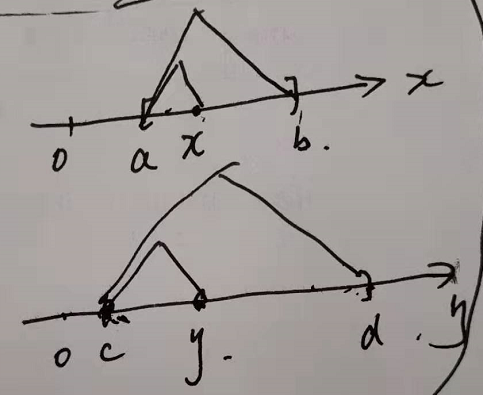
5. Parity of Derivatives and Integrals
1. Parity of Derivatives
\[\begin{align} &(1) \text{ If } f(x) \text{ is odd:}\\ &f(-x)=-f(x) \implies -f'(-x)=-f'(x) \implies f'(-x)=f'(x) \implies f'(x) \text{ is even.}\\ &(2) \text{ If } f(x) \text{ is even:}\\ &f(-x)=f(x) \implies -f'(-x)=f'(x) \implies f'(-x)=-f'(x) \implies f'(x) \text{ is odd.}\\ \end{align}\]2. Parity of Integrals
\[\begin{align} &\text{Let } F(x) = \int_0^x f(t)dt:\\ &(1) \text{ If } f(x) \text{ is odd, then } F(x) \text{ is even.}\\ &(2) \text{ If } f(x) \text{ is even, then } F(x) \text{ is odd.}\\ \end{align}\]3. Parity of Composite Functions
\[\begin{align} &\text{Let } F(x)=f(g(x)):\\ &\text{If } f(x) \text{ is even } \implies F(x) \text{ is always even.}\\ &\text{If } f(x) \text{ is odd and } g(x) \text{ is odd } \implies F(x) \text{ is odd.}\\ &\text{If } f(x) \text{ is odd and } g(x) \text{ is even } \implies F(x) \text{ is even.}\\ &\text{Rule of thumb: "Outer even makes it even, outer odd follows the inner."}\\ \end{align}\]Examples: \(\begin{align} &1. \text{ Let } M=\int_{-\frac{\pi}{2}}^{\frac{\pi}{2}}{\frac{\sin x}{1+x^2}\cos^4xdx}, \quad N=\int_{-\frac{\pi}{2}}^{\frac{\pi}{2}}{(\sin^3 x+\cos^4x)dx}, \quad P=\int_{-\frac{\pi}{2}}^{\frac{\pi}{2}}(x^2\sin^3x-\cos^4x)dx. \text{ Then:}\\ &\text{(A) } N<P<M \quad \text{(B) } M<P<N \quad \text{(C) } N<M<P \quad \text{(D) } P<M<N\\ &\text{Solution: By symmetry,}\\ &M: \text{ The integrand is odd } \implies M = 0.\\ &N = \int_{-\frac{\pi}{2}}^{\frac{\pi}{2}}\sin^3 xdx + \int_{-\frac{\frac{\pi}{2}}^{\frac{\pi}{2}}\cos^4 xdx = 0 + 2\int_0^{\frac{\pi}{2}}\cos^4 xdx > 0 \implies N > 0.\\ &P = \int_{-\frac{\pi}{2}}^{\frac{\pi}{2}}x^2\sin^3 xdx - \int_{-\frac{\pi}{2}}^{\frac{\pi}{2}}\cos^4 xdx = 0 - 2\int_0^{\frac{\pi}{2}}\cos^4 xdx < 0 \implies P < 0.\\ &\implies P < M < N. \quad \text{Choose (D).}\\ \end{align}\)
\[\begin{align} &2. \text{ Given } f(x)=\begin{cases}&kx, \quad 0\leq x\leq \frac{1}{2}a\\&c, \quad \frac{1}{2}a<x\leq a\\\end{cases}, \text{ find } F(x)=\int_0^xf(t)dt \text{ for } x\in[0,a].\\ &\text{Solution:}\\ &\text{For } 0 \leq x \leq \frac{1}{2}a: \quad F(x) = \int_0^x kt dt = \frac{1}{2}kx^2\\ &\text{For } \frac{1}{2}a < x \leq a: \quad F(x) = \int_0^{\frac{1}{2}a} kt dt + \int_{\frac{1}{2}a}^x c dt = \frac{1}{8}ka^2 + c\left(x-\frac{1}{2}a\right)\\ \end{align}\] \[\begin{align} &3. \text{ Prove: } \int_0^{2\pi}f(|\cos x|)dx=4\int_0^{\frac{\pi}{2}}f(|\cos x|)dx\\ \end{align}\]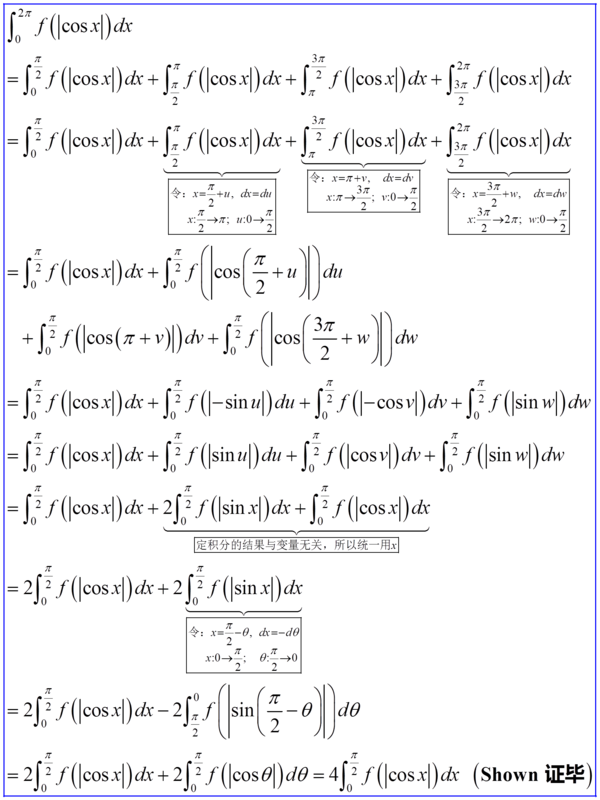
6. Established Formulas
\[\begin{align} &(1) \text{ Wallis' Formula: } \int_0^{\frac{\pi}{2}}{\sin^nxdx}=\int_0^{\frac{\pi}{2}}\cos^n xdx=\begin{cases}\frac{n-1}{n}\cdot\frac{n-3}{n-2}\cdots\frac{1}{2}\cdot\frac{\pi}{2},&n \text{ is even}\\\frac{n-1}{n}\cdot\frac{n-3}{n-2}\cdots\frac{2}{3},&n \text{ is odd } (>1)\end{cases}\\ &(2) \int_0^{\pi}xf(\sin x)dx=\frac{\pi}{2}\int_0^{\pi}f(\sin x)dx \quad (f(x) \text{ is continuous})\\ \end{align}\]7. Definite Integral Proofs
8. Classical Examples:
Example 1:
\[\begin{align} &\text{Evaluate } \lim_{n\rightarrow \infty}{\left(\frac{1}{n+1}+\frac{1}{n+2}+\cdots+\frac{1}{n+n}\right)}\\ &\text{Method 1: Riemann Sum (Definite Integral Definition)}\\ &\lim_{n\rightarrow \infty} \sum_{i=1}^n \frac{1}{n+i} = \lim_{n\rightarrow \infty} \frac{1}{n} \sum_{i=1}^n \frac{1}{1+\frac{i}{n}} = \int_0^1 \frac{1}{1+x} dx = \ln(1+x)\Big|_0^1 = \ln 2\\ \end{align}\]Example 2
\[\begin{align} &\text{Let } f(x)=\int_0^x{\frac{\sin t}{\pi-t}dt}, \text{ evaluate } \int_0^{\pi}f(x)dx.\\ &\text{Method 1: Integration by Parts}\\ &\text{Identical to Example III.2(1), yielding a result of } 2.\\ \end{align}\]Example 3

 \(\begin{align}
&\text{Method 1: Construct an auxiliary function}\\
&\text{From the problem, } f(1)=f(-1)=1, f(0)=-1. \text{ Assuming an even polynomial function like } f(x)=2x^2-1:\\
&\text{We can test the conditions to match the graph trends directly.}\\
\end{align}\)
\(\begin{align}
&\text{Method 1: Construct an auxiliary function}\\
&\text{From the problem, } f(1)=f(-1)=1, f(0)=-1. \text{ Assuming an even polynomial function like } f(x)=2x^2-1:\\
&\text{We can test the conditions to match the graph trends directly.}\\
\end{align}\)
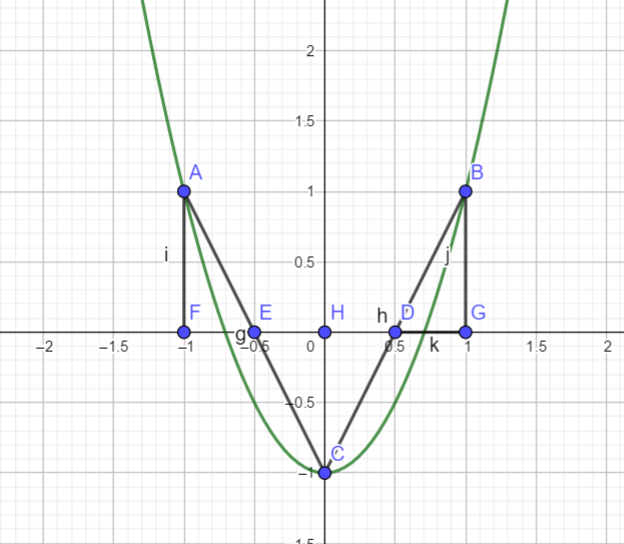
Example 4
AZZK.jpg)
Improper Integrals
I. Improper Integrals over Infinite Intervals
\[\begin{align} &(1) \int_a^{+\infty}{f(x)}dx=\lim_{t\rightarrow +\infty}{\int_{a}^{t}f(x)dx}\\ &(2) \int_{-\infty}^{b}{f(x)}dx=\lim_{t\rightarrow -\infty}{\int_{t}^{b}f(x)dx}\\ &(3) \int_{-\infty}^{+\infty}{f(x)}dx = \int_{-\infty}^{c}{f(x)}dx + \int_{c}^{+\infty}{f(x)}dx. \text{ If both converge, the total integral converges.}\\ &\text{Common convergence p-test criterion: } \int_a^{+\infty}{\frac{1}{x^p}dx} \quad (a>0) \begin{cases}\text{Converges}, & p>1\\\text{Diverges}, & p\leq1\end{cases}\\ \end{align}\]II. Improper Integrals of Unbounded Functions (Inproper Integrals with Discontinuities / Type II)
\[\begin{align} &\text{If } f(x) \text{ becomes unbounded near a point } a, \text{ then } a \text{ is called a singularity (or vertical asymptote).}\\ &(1) \text{ If } a \text{ is the singularity on } (a,b]: \quad \int_{a}^{b}f(x)dx=\lim_{t\rightarrow a^+}{\int_{t}^{b}{f(x)dx}}\\ &(2) \text{ If } b \text{ is the singularity on } [a,b): \quad \int_a^bf(x)dx=\lim_{t\rightarrow b^-}{\int_a^tf(x)dx}\\ &(3) \text{ If } c \in (a,b) \text{ is a singularity, split the integral at } c. \text{ Both pieces must converge for the whole to converge.}\\ &\text{Common convergence p-test criterion:}\\ &\int_a^b{\frac{1}{(x-a)^p}dx} \text{ or } \int_a^b{\frac{1}{(b-x)^p}dx} \begin{cases}\text{Converges}, & p<1\\\text{Diverges}, & p\geq 1\end{cases}\\ \end{align}\]III. Examples
Example 1
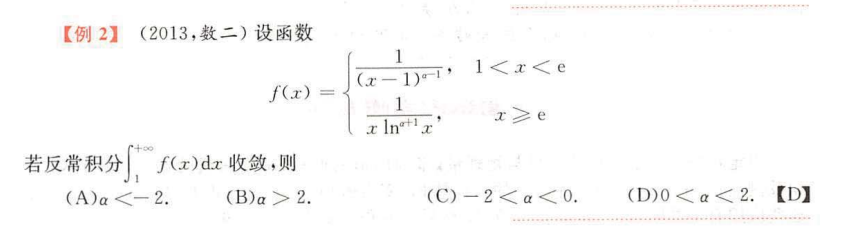 \(\begin{align}
&\text{Analyze convergence by splitting at the singularity } x=1 \text{ and assessing infinity behavior.}\\
\end{align}\)
\(\begin{align}
&\text{Analyze convergence by splitting at the singularity } x=1 \text{ and assessing infinity behavior.}\\
\end{align}\)
Applications of Definite Integrals
The Element Method (Differential Elements)
\[\begin{align} &dA = f(x)dx, \quad dV = \pi f^2(x)dx\\ \end{align}\]I. Geometric Applications
1. Area of a Plane Region
\[\begin{align} &(1) \text{ Cartesian Coordinates: } S=\int_a^b{[f(x)-g(x)]dx \quad \text{where } f(x)\geq g(x)}\\ &(2) \text{ Polar Coordinates: } S=\frac{1}{2}\int_{\alpha}^{\beta}{\rho^2(\theta)d\theta}\\ \end{align}\]2. Volume of a Solid of Revolution
\[\begin{align} &\text{Let a region } D \text{ be bounded by } y=f(x) \geq 0, x=a, x=b, \text{ and the } x\text{-axis:}\\ &(1) \text{ Rotation about the } x\text{-axis: } V_x=\pi\int_a^b{f^2(x)dx}\\ &(2) \text{ Rotation about the } y\text{-axis (Shell Method): } V_y=2\pi\int_a^b{xf(x)dx}\\ \end{align}\]HIN4FCVUKI$$%5DZB.jpg) \(\begin{align}
&\text{Volumes of revolution for regions bounded by lines like } y=x, y=x^2:\\
&V_x = \pi\int_0^1 (x^2 - (x^2)^2)dx\\
&V_y = 2\pi\int_0^1 x(x - x^2)dx\\
\end{align}\)
\(\begin{align}
&\text{Volumes of revolution for regions bounded by lines like } y=x, y=x^2:\\
&V_x = \pi\int_0^1 (x^2 - (x^2)^2)dx\\
&V_y = 2\pi\int_0^1 x(x - x^2)dx\\
\end{align}\)
3. Arc Length of a Plane Curve
\[\begin{align} &(1) \text{ Explicit Form } y=y(x): \quad s=\int_a^b{\sqrt{1+y'^2}dx}\\ &(2) \text{ Parametric Form } \begin{cases}x=x(t)\\y=y(t)\end{cases}: \quad s=\int_{\alpha}^{\beta}{\sqrt{x'^2+y'^2}dt}\\ &(3) \text{ Polar Form } \rho=\rho(\theta): \quad s=\int_{\alpha}^{\beta}{\sqrt{\rho^2+\rho'^2}d\theta}\\ \end{align}\]4. Lateral Surface Area of a Solid of Revolution
\[\begin{align} &\text{Surface area generated by revolving curve } y=f(x) \text{ around the } x\text{-axis:}\\ &S=2\pi\int_a^b{f(x)\sqrt{1+f'^2(x)}dx}\\ \end{align}\]II. Physical Applications
1. Hydrostatic Pressure
2. Work Done by a Variable Force
3. Gravitational Attraction
Example 1

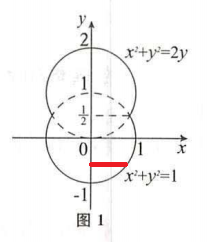 \(\begin{align}
&\text{Work elements: } dW = \rho g \cdot A(y) \cdot (\text{distance}) dy\\
\end{align}\)
\(\begin{align}
&\text{Work elements: } dW = \rho g \cdot A(y) \cdot (\text{distance}) dy\\
\end{align}\)
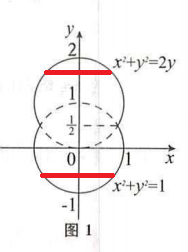
Example 2
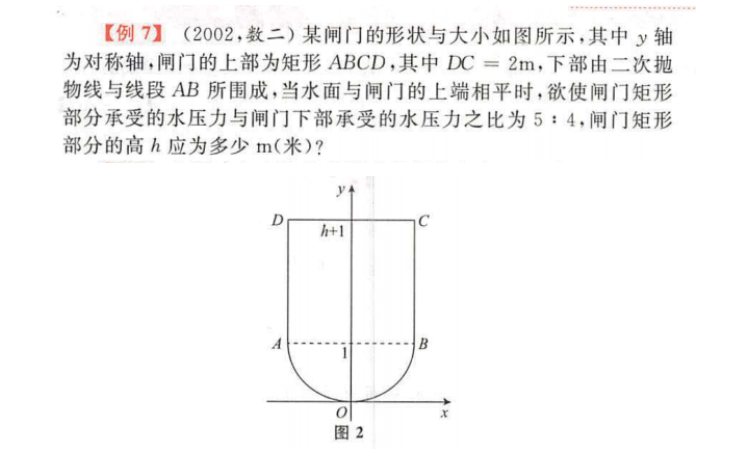 \(\begin{align}
&F = \int \rho g h \cdot b(y) dy\\
\end{align}\)
\(\begin{align}
&F = \int \rho g h \cdot b(y) dy\\
\end{align}\)
.jpg)