Differential Equations
I. Basic Concepts of Ordinary Differential Equations
1. Differential Equation
\[y'=2x\]An equation containing the derivatives or differentials of an unknown function.
2. Order of a Differential Equation
\[\text{1st-order equation}\]The highest order of the derivative of the unknown function that appears in the differential equation.
3. Solution of a Differential Equation
\[y=f(x)=x^2\]A function that satisfies the differential equation.
4. General Solution of a Differential Equation
\[y=f(x)=x^2+c\]A solution of a differential equation that contains arbitrary constants, where the number of arbitrary constants matches the order of the differential equation.
5. Particular Solution of a Differential Equation
\[y=f(x)=x^2+1\]A solution of a differential equation that does not contain arbitrary constants.
6. Initial Conditions
A set of constants used to determine a particular solution.
7. Integral Curve
The geometric curve on a plane that corresponds to a single solution of the differential equation.
II. First-Order Differential Equations $y’=f(x,y)$
1. Separable Variables Equations
\[\begin{align} &y'=f(x)g(y)\Leftrightarrow \frac{dy}{dx}=f(x)g(y)\Leftrightarrow \frac{dy}{g(y)}=f(x)dx \\ &\text{Solution method: integrate both sides } \Leftrightarrow \int\frac{dy}{g(y)}=\int f(x)dx\\ \end{align}\]2. Homogeneous Differential Equations
\[\begin{align} &\frac{dy}{dx}=\Phi\left(\frac{y}{x}\right)\\ &\text{Method: Let } u=\frac{y}{x}, \; y=ux, \; y'=u+u'x\\ \end{align}\]Example
 \(\begin{align}
&y'+\frac{y}{x}=\left(\frac{y}{x}\right)^2\\
&\text{Let } u=\frac{y}{x}, \; y=ux, \; y'=u+u'x\\
&\Leftrightarrow u+u'x+u=u^2\\
&\Leftrightarrow u+\frac{du}{dx}x+u=u^2\\
&\Leftrightarrow \frac{du}{u^2-2u}=\frac{1}{x}dx\\
&\Leftrightarrow \int\frac{du}{u^2-2u}=\int\frac{1}{x}dx\\
&\Leftrightarrow \frac{1}{2}(\ln|u-2|-\ln|u|)=\ln|x|+C\\
&\Leftrightarrow \frac{u-2}{u}=Cx^2\\
\end{align}\)
\(\begin{align}
&y'+\frac{y}{x}=\left(\frac{y}{x}\right)^2\\
&\text{Let } u=\frac{y}{x}, \; y=ux, \; y'=u+u'x\\
&\Leftrightarrow u+u'x+u=u^2\\
&\Leftrightarrow u+\frac{du}{dx}x+u=u^2\\
&\Leftrightarrow \frac{du}{u^2-2u}=\frac{1}{x}dx\\
&\Leftrightarrow \int\frac{du}{u^2-2u}=\int\frac{1}{x}dx\\
&\Leftrightarrow \frac{1}{2}(\ln|u-2|-\ln|u|)=\ln|x|+C\\
&\Leftrightarrow \frac{u-2}{u}=Cx^2\\
\end{align}\)
3. First-Order Linear Differential Equations
\[\begin{align} &\text{Form: } y'+p(x)y=Q(x)\\ &\text{General Solution: } y=e^{-\int p(x)dx}\left[\int Q(x)e^{\int p(x)dx}dx+C\right]\\ \end{align}\]4. Bernoulli Equations
\[\begin{align} &\text{Form: } y'+p(x)y=Q(x)y^n \quad (n \neq 0,1)\\ &\text{Method: Let } u=y^{1-n}\\ &y^{-n}y'+p(x)y^{1-n}=Q(x)\\ &\text{Let } u=y^{1-n}\\ &(1-n)y^{-n}y'=\frac{du}{dx}\\ \end{align}\] \(\begin{align}
&\text{Observing that the differential equation contains } y'', \; y', \text{ and } y, \text{ it belongs to the form } y''=f(y,y').\\
&\text{Let } y'=p, \; y''=p\frac{dp}{dy}.\\
&\text{Yielding: } yp\frac{dp}{dy}+p^2=0\\
&\Leftrightarrow p\left(y\frac{dp}{dy}+p\right)=0\\
&\text{When } p=0, \text{ the equation holds, but according to the initial condition } y'|_{x=0}=1,\\
&\text{the solution } p=0 \text{ contradicts it.}\\
&\Leftrightarrow \int\frac{dp}{p}=-\int\frac{dy}{y}\\
&\Leftrightarrow |py|=e^C\\
&\Leftrightarrow p=\frac{C}{y}\\
&\Leftrightarrow \frac{dy}{dx}=\frac{C}{y}\\
&\text{According to the initial condition } y'|_{x=0}=\frac{1}{2} \Leftrightarrow C=\frac{1}{2}.\\
&\Leftrightarrow y^2=x+C_2\\
&\text{According to the initial condition } y|_{x=0}=1 \Rightarrow 1^2=0+C_2 \Rightarrow C_2=1 \Rightarrow y^2=x+1.\\
&\text{Since } y|_{x=0}=1 > 0, \text{ we have } y=\sqrt{x+1}.
\end{align}\)
\(\begin{align}
&\text{Observing that the differential equation contains } y'', \; y', \text{ and } y, \text{ it belongs to the form } y''=f(y,y').\\
&\text{Let } y'=p, \; y''=p\frac{dp}{dy}.\\
&\text{Yielding: } yp\frac{dp}{dy}+p^2=0\\
&\Leftrightarrow p\left(y\frac{dp}{dy}+p\right)=0\\
&\text{When } p=0, \text{ the equation holds, but according to the initial condition } y'|_{x=0}=1,\\
&\text{the solution } p=0 \text{ contradicts it.}\\
&\Leftrightarrow \int\frac{dp}{p}=-\int\frac{dy}{y}\\
&\Leftrightarrow |py|=e^C\\
&\Leftrightarrow p=\frac{C}{y}\\
&\Leftrightarrow \frac{dy}{dx}=\frac{C}{y}\\
&\text{According to the initial condition } y'|_{x=0}=\frac{1}{2} \Leftrightarrow C=\frac{1}{2}.\\
&\Leftrightarrow y^2=x+C_2\\
&\text{According to the initial condition } y|_{x=0}=1 \Rightarrow 1^2=0+C_2 \Rightarrow C_2=1 \Rightarrow y^2=x+1.\\
&\text{Since } y|_{x=0}=1 > 0, \text{ we have } y=\sqrt{x+1}.
\end{align}\)
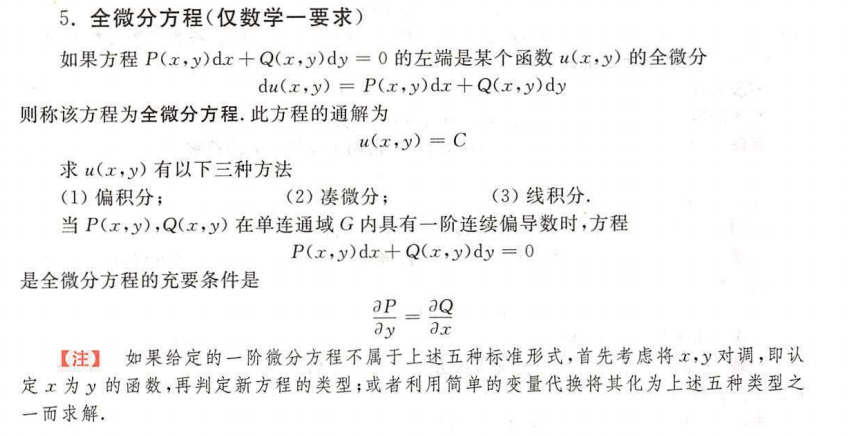
5. Exact Differential Equations
III. Higher-Order Equations Reducible in Order
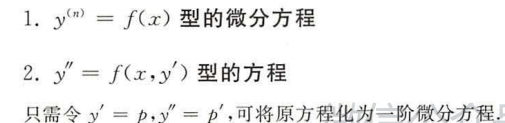 \(\begin{align}
&y'=p=\frac{dy}{dx}, \; y''=\frac{dp}{dx}\\
&y''=f(x,y') \Leftrightarrow \frac{dp}{dx}=f(x,p)
\end{align}\)
\(\begin{align}
&y'=p=\frac{dy}{dx}, \; y''=\frac{dp}{dx}\\
&y''=f(x,y') \Leftrightarrow \frac{dp}{dx}=f(x,p)
\end{align}\)
 \(\begin{align}
&x\frac{dp}{dx}+3p=0\\
&\int{\frac{1}{p}dp}=-3\int{\frac{1}{x}dx} \quad (\text{Note: standard substitution step})\\
&p=\frac{C_1}{x^3}\\
&\frac{dy}{dx}=\frac{C_1}{x^3}\\
&y=\frac{C_2}{x^2}+C_1\\
\end{align}\)
\(\begin{align}
&x\frac{dp}{dx}+3p=0\\
&\int{\frac{1}{p}dp}=-3\int{\frac{1}{x}dx} \quad (\text{Note: standard substitution step})\\
&p=\frac{C_1}{x^3}\\
&\frac{dy}{dx}=\frac{C_1}{x^3}\\
&y=\frac{C_2}{x^2}+C_1\\
\end{align}\)
 \(\begin{align}
&y'=p=\frac{dy}{dx}, \; y''=\frac{dp}{dx}\\
&\text{Yielding } \frac{dp}{dy}=f(y,p) \text{ when handled via substitution.}\\
&\text{Let } y'=p=\frac{dy}{dx}, \; y''=\frac{dp}{dx}=\frac{dp}{dy}\frac{dy}{dx}=\frac{dp}{dy}p\\
&\text{Yielding: } \frac{dp}{dy}p=f(y,p)\\
\end{align}\)
\(\begin{align}
&y'=p=\frac{dy}{dx}, \; y''=\frac{dp}{dx}\\
&\text{Yielding } \frac{dp}{dy}=f(y,p) \text{ when handled via substitution.}\\
&\text{Let } y'=p=\frac{dy}{dx}, \; y''=\frac{dp}{dx}=\frac{dp}{dy}\frac{dy}{dx}=\frac{dp}{dy}p\\
&\text{Yielding: } \frac{dp}{dy}p=f(y,p)\\
\end{align}\)
 \(\begin{align}
&y\frac{dp}{dy}p+p^2=0\\
&\int\frac{dp}{p}=-\int\frac{dy}{y}\\
&py=C_1\\
&p=\frac{C_1}{y}\\
&\frac{dy}{dx}=\frac{C_1}{y}\\
&\text{Since } y'|_{x=0}=\frac{1}{2}\\
&\frac{dy}{dx}=\frac{\frac{1}{2}}{y}\\
&y^2=x+C_2\\
&\text{Since } y|_{x=0}=1\\
&y=\sqrt{x+1}\\
\end{align}\)
\(\begin{align}
&y\frac{dp}{dy}p+p^2=0\\
&\int\frac{dp}{p}=-\int\frac{dy}{y}\\
&py=C_1\\
&p=\frac{C_1}{y}\\
&\frac{dy}{dx}=\frac{C_1}{y}\\
&\text{Since } y'|_{x=0}=\frac{1}{2}\\
&\frac{dy}{dx}=\frac{\frac{1}{2}}{y}\\
&y^2=x+C_2\\
&\text{Since } y|_{x=0}=1\\
&y=\sqrt{x+1}\\
\end{align}\)
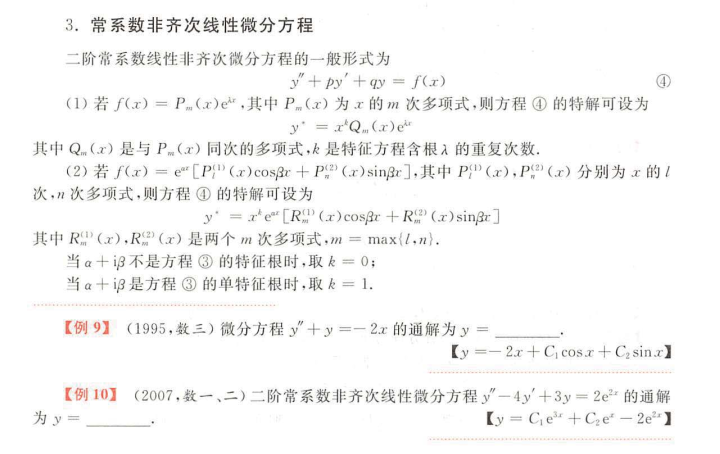
IV. Higher-Order Linear Differential Equations
.jpg)
.jpg) \(\begin{align}
&y''+py'+qy=0 \Leftrightarrow r^2+pr+q=0\\
&\text{Finding conjugate complex roots: } r_{1},r_2=\frac{-b\pm i\sqrt{4ac-b^2}}{2a} \quad (i^2=-1)\\
&\text{Example: If } y=xe^x \text{ is a solution to } y''+py'+qy=0,\\
&\text{then } (r-1)^2=0 \text{ must be the characteristic equation.}\\
&r^2-2r+1=0\\
&\text{Hence, } p=-2, \; q=1.\\
\end{align}\)
\(\begin{align}
&y''+py'+qy=0 \Leftrightarrow r^2+pr+q=0\\
&\text{Finding conjugate complex roots: } r_{1},r_2=\frac{-b\pm i\sqrt{4ac-b^2}}{2a} \quad (i^2=-1)\\
&\text{Example: If } y=xe^x \text{ is a solution to } y''+py'+qy=0,\\
&\text{then } (r-1)^2=0 \text{ must be the characteristic equation.}\\
&r^2-2r+1=0\\
&\text{Hence, } p=-2, \; q=1.\\
\end{align}\)
.jpg) \(\begin{align}
&r^2-r+\frac{1}{4}=0\\
&\left(r-\frac{1}{2}\right)^2=0\\
&r_1=r_2=\frac{1}{2}\\
&y=e^{\frac{1}{2}x}(C_1+C_2x)\\
\end{align}\)
\(\begin{align}
&r^2-r+\frac{1}{4}=0\\
&\left(r-\frac{1}{2}\right)^2=0\\
&r_1=r_2=\frac{1}{2}\\
&y=e^{\frac{1}{2}x}(C_1+C_2x)\\
\end{align}\)
.jpg) \(\begin{align}
&r^2+2r+5=0\\
&r_{1,2}=\frac{-2\pm i\sqrt{4-20}}{2}=-1\pm 2i\\
&y=e^{-x}(C_1\cos{2x}+C_2\sin{2x})
\end{align}\)
\(\begin{align}
&r^2+2r+5=0\\
&r_{1,2}=\frac{-2\pm i\sqrt{4-20}}{2}=-1\pm 2i\\
&y=e^{-x}(C_1\cos{2x}+C_2\sin{2x})
\end{align}\)
.jpg) \(\begin{align}
&r^3-2r^2+r-2=0\\
&r^2(r-2)+(r-2)=0\\
&(r-2)(r^2+1)=0\\
&r_1=2, \; r_{2,3}=\pm i\\
&y=C_1e^{2x}+C_2\cos{x}+C_3\sin{x}\\
\end{align}\)
\(\begin{align}
&r^3-2r^2+r-2=0\\
&r^2(r-2)+(r-2)=0\\
&(r-2)(r^2+1)=0\\
&r_1=2, \; r_{2,3}=\pm i\\
&y=C_1e^{2x}+C_2\cos{x}+C_3\sin{x}\\
\end{align}\)
 \(\begin{align}
&\text{Core Solution Strategy: Find the particular solution of the homogeneous equation.}\\
\end{align}\)
\(\begin{align}
&\text{Core Solution Strategy: Find the particular solution of the homogeneous equation.}\\
\end{align}\)
.jpg) \(\begin{align}
&D=\frac{d}{dt}\\
&\text{Let } x=e^t \text{ or } t=\ln x, \; t'=\frac{dt}{dx}=\frac{1}{x}\\
&y'=\frac{dy}{dx}=\frac{dy}{dt}\frac{dt}{dx}=\frac{1}{x}\frac{dy}{dt}\\
&xy'=\frac{dy}{dt}=Dy\\
&y''=\left(\frac{1}{x}\frac{dy}{dt}\right)'=\left(\frac{dy}{dt}\right)'\frac{1}{x}-\frac{1}{x^2}\frac{dy}{dt}=\frac{d^2y}{dt^2}\frac{dt}{dx}\frac{1}{x}-\frac{1}{x^2}\frac{dy}{dt}=\frac{d^2y}{dt^2}\frac{1}{x^2}-\frac{1}{x^2}\frac{dy}{dt} \Rightarrow x^2y''=D(D-1)y\\
\end{align}\)
\(\begin{align}
&D=\frac{d}{dt}\\
&\text{Let } x=e^t \text{ or } t=\ln x, \; t'=\frac{dt}{dx}=\frac{1}{x}\\
&y'=\frac{dy}{dx}=\frac{dy}{dt}\frac{dt}{dx}=\frac{1}{x}\frac{dy}{dt}\\
&xy'=\frac{dy}{dt}=Dy\\
&y''=\left(\frac{1}{x}\frac{dy}{dt}\right)'=\left(\frac{dy}{dt}\right)'\frac{1}{x}-\frac{1}{x^2}\frac{dy}{dt}=\frac{d^2y}{dt^2}\frac{dt}{dx}\frac{1}{x}-\frac{1}{x^2}\frac{dy}{dt}=\frac{d^2y}{dt^2}\frac{1}{x^2}-\frac{1}{x^2}\frac{dy}{dt} \Rightarrow x^2y''=D(D-1)y\\
\end{align}\)